K-State leads in biomanufacturing
By Grant Guggisberg
Kansas State University is all-in on biomanufacturing.
With the USDA’s National Bio and Agro-Defense Facility finally complete and operational, the university is moving forward with plans to make K-State a regional hub for biomanufacturing 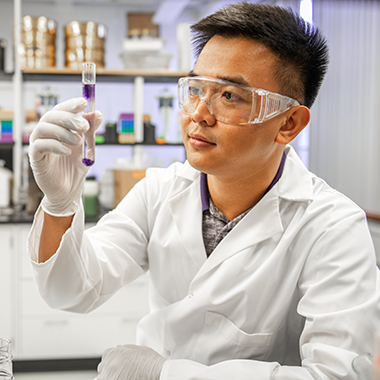
of animal health products, from research and development all the way through the final production phase of the process.
Officially known as the Biomanufacturing Training and Education Initiative, this comprehensive program is designed to position Kansas as a national leader in biomanufacturing and biosecurity. The university is committing a wide variety of resources to realizing its goals, including the hiring of 12 new faculty members to support the growth of biomanufacturing at K-State.
The Carl R. Ice College of Engineering is doing its part to support this multidisciplinary effort through creation of the Biomanufacturing Laboratory and Training Facility currently under construction on the north end of Seaton Hall.
Once the remodeled area is completed, the Biomanufacturing Laboratory and Training Facility will feature nearly 2,300 square feet of cutting-edge training space designed to offer applied learning opportunities for students in the agricultural technology management degree’s biomanufacturing technology option, biological systems engineering degree, and related programs in the college as well as in STEM fields across campus who have an interest in pursuing a career in this emerging industry.
To make the facility a reality, Lisa R. Wilken, associate professor of biological and agricultural engineering and director of the new facility, has led the lab progression and equipment procurement over the past three years and is currently overseeing the development of the new biomanufacturing undergraduate certificate program.
“We’re essentially building a mini
biomanufacturing plant,” Wilken said.
“It will have equipment that gives students the hands-on experience and perspective of how to work in this industry at a small scale, but in a way that translates to the large scale.
“It will have the whole bioprocessing line with necessary and industry-relevant equipment needed to manufacture biologics.”
A growing industry
What exactly is biomanufacturing?
Mark Wilkins, professor and head of the Carl and Melinda Helwig Department of Biological and Agricultural Engineering, said a wide variety of products are developed through this process.
“It’s basically anything you can use a living cell to make,” Wilkins said.
Wilkins mentioned biologic drugs and therapeutics, vaccines, and consumable products like bioplastics are all created through this process. Many new advanced pharmaceuticals being developedand already in use were biomanufactured from living cells.
Wilken said these cells can come from a variety of sources, whether created and grown in a bioreactor in a lab, or even extracted from the seeds of genetically modified plants, essentially using the plant as an incubator.
“We have a wide variety of different cells that we could use to produce the things we need,” Wilken said. “Whether it’s a therapeutic for health, a diagnostic protein for disease detection, or an innovative food or feed ingredient – we’re just harnessing the power of living systems.”
Wilken said one of the most important uses of this technology is in the development of monoclonal antibodies, which bind to one antigen only and work as a more targeted treatment of many difficult to treat diseases, such as cancer.
“You need the infrastructure to grow the cells that are capable of producing the antibody and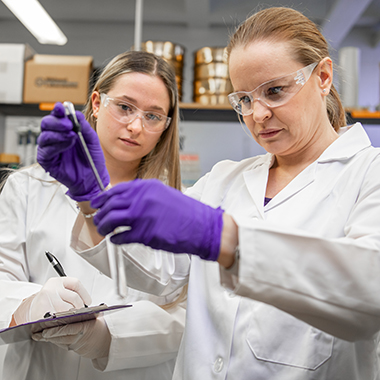 then you have to purify it to a very high level,” she said. “Animal health and human health industries are highly regulated, and for good reason. But we can essentially do that whole production line, from cell culture all the way down to the purification and formulation of an antibody.”
Training the next generation
The Biomanufacturing Laboratory and Training Facility was funded by the state of Kansas with the idea that it would be used primarily as an undergraduate teaching lab aimed at providing practical experience and hands-on training for students across campus.
Xinyi “Abby” E, professor of practice of biological and agricultural engineering and assistant director of the facility, was hired in 2022 to spearhead the course development critical for the multidisciplinary undergraduate certificate program in biomanufacturing, which will be offered alongside existing degree options in agricultural technology management and biological systems engineering.
“What will set this program apart for our students is the lab courses we’ll be offering and the hands-on experience our students can gain,” E said. “This is the same equipment being used by industry in this field, just on a smaller production scale.”
E said the plan is to encourage students to explore these courses, which include an introduction to biomanufacturing, upstream and downstream processing, as well as complementary lab courses focused on large-scale production of biologics and nontherapeutics. Additionally, a regulatory course centered on Good Manufacturing Practice standards and compliance will offer deeper insights into product quality assurance and risk management in the biomanufacturing industry.
“We feel it’s essential to have this newly renovated lab and to have all the small-scale equipment being used in industry,” E said. “We are aiming to continuously tailor and modify the curriculum based on the job market and industry demand so our students can be part of this new workforce.”
Wilken said the team will be diligent in recruiting new students to the program once the curriculum is finalized and approved.
“With these facilities, we need to be strong on recruitment to the programs,” she said. “We don’t produce enough graduates right now to really sustain the growth that we’re seeing in the industry in this region.”
While the certificate program and laboratory-based courses are still in the final stages of development, Wilken stressed the importance of being a reliable training source for anyone looking to work in this field, from current students to nondegree-seeking students looking to reskill or upskill for this growing industry.
“Our goal, overall, is to be a regional hub for training and education for our degree-seeking students, but also for industry,” she said. “Having that training program established is important for companies. They need to know that they’re going to be supported and have the workforce they need.”