Rising innovators
Two faculty members in the Carl R. Ice College of Engineering each secured Faculty Early Career Development, or CAREER, awards from the National Science Foundation this spring. These significant milestone grants are designed to reward young and promising researchers. Below are brief summaries of each faculty member’s ongoing projects awarded through this prestigious NSF grant process.
Automated security risk detection
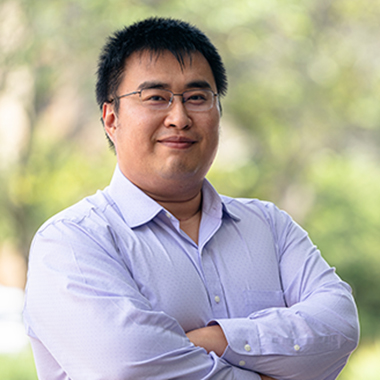 Xiaolong Guo, assistant professor in the Mike Wiegers Department of Electrical and Computer Engineering, has received a $490,000 CAREER award to develop an automated tool to detect security issues in computer hardware without human effort or specialized knowledge.
The five-year project, “CAREER: When Learning Meets Reasoning: Mitigating Security Risks with Large Language Models and Causality Inference,” will also integrate a dataset to train large language models and feature a cloud-based platform for testing solutions.
In addition to producing the automated tools to detect hardware security issues, the project aims to deliver enhanced hardware security via its cloud-based testing platform, as well as foster more collaboration with industry.
The project will also produce educational resources designed to inspire and train future engineers involved in hardware security.
Climate-smart practices and improved water sustainability
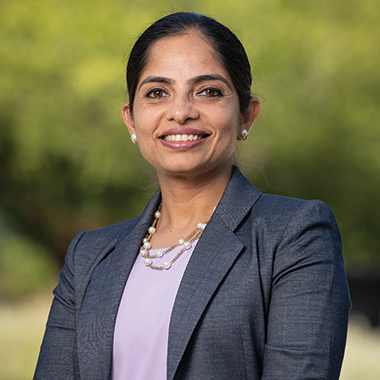 Vaishali Sharda, associate professor in the Carl and Melinda Helwig Department of Biological and Agricultural Engineering, has received a more than $500,000 CAREER award to develop a tool that can generate multiple future climate scenarios for crop production.
The five-year project, “CAS-Climate: Multiscale Data and Model Synthesis Informed Approach for Assessing Climate Resilience of Crop Production Systems,” intends to create an all-in-one system that can help crop producers better sustain water resources, as well as manage nutrients and soils, by combining inputs from on-the-ground sensors and satellite and remotely sensed data.
The project will build research and educational capacity for developing and refining modeling capabilities across different scales in space and time by linking a variety of data sources with a novel modeling framework.