Graduate Student of the Month
Carl R. Ice College of Engineering recognizes one outstanding graduate student from each department during the academic year. This program was established to enhance graduate student recognition and development. Students are nominated each month by their department heads.
December 2021 recognitions
 Bailey is researching innovative lateral systems to resist seismic forces in mass timber structures. Two of the systems he is researching in depth are rocking timber walls (walls that rock and roll with the motion of the seismic forces) and interstory isolation systems (isolating a building into two or more vertical portions in order to reduce connection damage in lateral systems). Bailey is from Raymore, Missouri. His hobbies include table tennis, board games and podcasting. His favorite food is chicken squares, and he would like to participate in the Amazing Race. Bailey’s advisor is Bill Zhang.
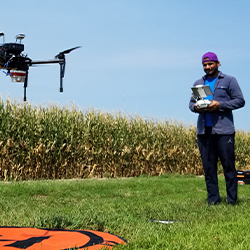 Gadhwal is working in precision agriculture to develop a sensor package for precise image positioning, orientation and mapping of captured aerial images using uncooled thermal infrared (TIR) sensor and visible-near infrared camera (VIS-NIR) aboard an unmanned aerial vehicle (UAV) to accurately assess crop canopy temperature pertinent to water stress and develop a plant stress-based autonomous and precise irrigation structure. Gadhwal is from Haryana, India, and enjoys playing cricket, volleyball and watching movies. His favorite food is homemade Indian food. Topping his bucket list is to explore Mykonos, Santorini (Greek islands) and Spain. Ajay Sharda is his advisor.
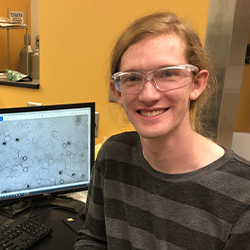 Growing hexagonal boron nitride (hBN) single crystals via the solution growth method is Janzen’s research focus. hBN is a wide-bandgap semiconductor that has a wide range of applications in devices and is particularly useful in devices using two-dimensional materials like graphene. The process he uses involves dissolving boron and nitrogen in molten metals at 1550°C, then slowly cooling this solution to precipitate the hBN crystals. Even though this process is conceptually simple, it is very difficult to optimize. To combat this, Janzen supplements his experiments with thermodynamics and mass transport calculations to make predictions of what changes are most likely to improve his process. Janzen is from Galva, Kansas. He enjoys playing video games with a strong emphasis on creativity like Cities Skylines, the Sims and Minecraft. He also enjoys working on DIY projects, listening to audio books, playing D&D, drawing, playing the piano and going for runs. On Janzen’s bucket list is to buy a Tesla when his current car dies. His advisor is James Edgar.
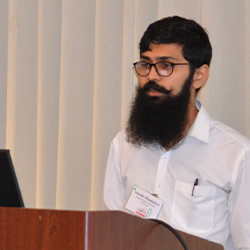
Mhamankar’s research focus is in the area of limiting states of concrete under shear-dominated stress-states. Recent research suggests that the tensile creep behavior of cementitious materials is fundamentally different than creep measured in uniaxial compression. Additionally, in the case of ductile materials, it was found that the failure characteristics are highly dependent on the stress-state. Hence, there has been an increased need for characterizing the time-dependent deformation of cement-based materials in different stress-states. The research investigates the role of stress-state in time-dependent deformation characteristics in cementitious materials, especially when loaded in shear, since there has been less research done on time-dependent shear deformation characteristics of cementitious materials. Mhamankar is from Maharashtra, India, and enjoys Indian cuisine. His hobbies include sketching, painting and hiking. Solo skydiving tops his bucket list. Christopher Jones is Mhamankar’s advisor.
 Edmonds' research enhances grid integration of renewables by utilizing market mechanisms and taking advantage of interdependencies within the food-energy-water nexus for demand-response techniques and unique energy-storage capabilities. The impact on the price of electricity from demand response from electricity-operated water pumps in municipal water networks and energy storage in elevated water tanks is investigated. Similarly, the impact on the price of electricity is investigated when a demand-responsive green ammonia plant and direct ammonia fuel cell are operated by an electricity distribution system operator. It is shown that this coupling can improve marginal electricity costs, reduce renewable energy curtailment, shift peak demands and provide energy storage solutions for excess renewable energy. Further, long-term energy storage in green ammonia provides benefits over traditional battery storage solutions that typically store energy for less than one day. This work can offer utilities a new tool to improve energy efficiencies and reduce operational costs as well as impact policies regarding interdependent food, energy and water networks. Edmonds is from Valley Falls, Kansas. Her hobbies include visiting friends and family, playing volleyball, traveling, reading and napping. Her favorite food is ice cream, and she would like to watch sea turtles hatch. Hongyu Wu is her advisor.
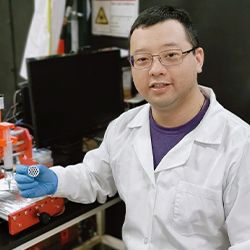 Yang’s research area is 3D Freeze Printing (3DFP) of advanced functional materials, including metals, ceramics and cellulose-based aerogels. 3DFP combines the advantages of freeze casting and additive manufacturing to fabricate multifunctional aerogels. Freeze casting is a cost-effective, efficient and versatile method capable of fabricating micro-scale porous structure inside the aerogels. The 3DFP provides the capability of fabricating highly customized geometries with controlled microporous structures as well. The aerogels they print have broad applications: The hydroxyapatite material has been widely applied to bone tissue engineering due to its biodegradable, biocompatible and osteoconductive properties. The scaffold printed with their method has superior compressive stress and strain, and it also contains interconnected pores which is good for tissue growth. They also print the nano-cellulose aerogels as ultra-lightweight sound absorbers, which can provide significantly higher absorption and transmission-loss properties. It has a great potential to be applied in the aerospace industries. Yang is from China and enjoys cooking, and his favorite food is pizza. Traveling to the moon is on his bucket list. Shuting Lei and Dong Lin are his advisors.
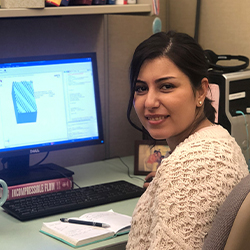
Soleimani’s research aims at providing a robust automated methodology for multi-objective optimization of 3D micro-fins on internal shape of heat exchangers, with a novel computational domain of two-sided periodic domains which represent a tiny channel flow with micro-fin on the upper and lower walls. Soleimani is from Iran and enjoys hiking, yoga, reading and watching Friends. Her favorite food is lamb kebab. She would like to travel to Italy, France, Japan, China and India and stay for two months in each of these countries. Steven Eckels is her advisor.